General Membership Meeting – Wednesday, June 10th

Fellow Pilots,

Your Executive Board invites active members to the quarterly General Membership Meeting.

Wednesday, June 10th at 11AM PDT (2PM EDT)

Your participation in this meeting will allow you to be engaged and informed on current affairs and the direction of our union.

To join the meeting, please follow the Zoom link provided below:

Register for the Webinar

If you have trouble accessing the button, use this link:

https://zoom.us/webinar/register/WN_Zxj1kAI8Q9Osrjjg3XcnsQ

Webinar ID: 938 6657 2150

We request that you join the meeting a few minutes prior to the scheduled time to ensure a smooth start. In accordance with our bylaws, in‑person attendance will be available at the Local 2118 office: 10000 W. Charleston Blvd., Suite 220, Las Vegas, NV 89135.

If you have any specific topics you would like to address during the open forum, please email them to us in advance at:

This will allow us to better prepare and provide you with accurate information during the meeting. As a reminder, any members asking questions during the meeting must identify themself by name and domicile. We will now require members to raise their hand and be unmuted to ask their question live. Please be sure to lower your hand if your question has already been answered or if you need to step away from the webinar.

We look forward to your participation and working together to address matters that impact us all.

Fraternally,

Your Executive Board


Negotiating Committee Update: Retention Bonus

Fellow Pilots,

The Negotiating Committee has received a significant number of questions regarding the timing of the Retention Bonus payout. Simply put, the Company will pay the Retention Bonus no later than October 1, 2026.

As discussions progressed with the Company during efforts to reach an Agreement in Principle (AIP), three primary issues emerged regarding payment of the Retention Bonus: First, clarification of eligibility and payment language for pilots on leaves of absence. Second, the timing of the Retention Bonus payout. Third, the dispute resolution process for potential payment inaccuracies.

Regarding eligibility clarification, the Union informed the Company that the phrase “actively employed” should include pilots on leaves of absence. After discussions with management, the Company agreed that any pilot on a paid or unpaid Leave of Absence will be considered “actively employed” for purposes of Retention Bonus eligibility and payment. Your Negotiating Committee believes this clarification was an important and meaningful protection for the pilot group.

Second, the Company informed the Union that it would pay out Retention Bonuses no later than October 1, 2026 if the forthcoming Tentative Agreement is ratified. Related, the Retention Bonus accrual would end on June 30, 2026. These terms will be included in the forthcoming Tentative Agreement that members in good standing will soon vote on.

As previously communicated, we expect the ratification process to conclude on June 30, 2026. We will provide timely notice of any changes to this anticipated ratification date. A pilot must be actively employed on the ratification date or retire from the Company due to reaching the FAA mandatory retirement age prior to ratification, in order to receive payment of the Retention Bonus.

The above-time frame provides for sufficient time for auditing, statement reconciliation, verification of calculations, and cooperative resolution of any discrepancies in Retention Bonus payout amounts. This approach provides a transparent and efficient process to help ensure each pilot receives the Retention Bonus they earned.

Third, both the Union and the Company recognized the need for a fair and efficient dispute resolution process in the event a pilot believes their payment amount is incorrect. The Union sought to establish a cooperative and efficient dispute resolution framework rather than forcing pilots to go through the traditional grievance, arbitration, and/or court process. The Company agreed.

The tentatively agreed upon process requires the Company to pay each pilot the amount calculated by the Company on or before October 1, while preserving the pilot’s right to seek additional compensation if they believe their payout amount is deficient. All challenges to payout amounts will be resolved by the agreed upon arbitrator in a single expedited arbitration proceeding, preceded by a 30-day meet-and-confer process during which the parties will attempt to resolve any and all payout disputes.

Your Negotiating Committee continues working diligently to convert the AIP language into a finalized Tentative Agreement that can be presented to the pilot group for a fair and informed vote.

Ratification of this agreement would secure long overdue improvements in pay, retirement contributions, and long-term disability protections that this pilot group has gone without for years. It would also establish an important foundation heading into future Joint Collective Bargaining negotiations. Without these improvements and protections in place beforehand, the pilot group’s leverage entering those discussions could be materially diminished

Fraternally,

Your Negotiating Committee

AIP Process and Initial Timeline

Fellow Pilots,

Last week, the Allegiant Board of Directors approved the Agreement in Principle between the Union Negotiating Committee and Company.

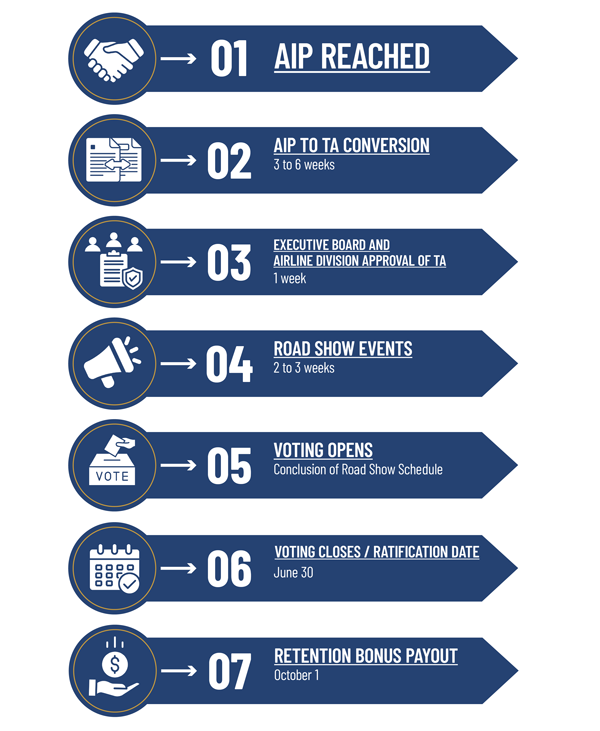
In the days since, many pilots have asked important questions about what comes next, what certain terms mean, and when key milestones will occur. The provided timeline outlines the key milestones leading up to ratification and implementation, while also providing clarity on the overall process from this point forward.

Below is an overview of key terms and the next steps in the process.

BRIDGE AGREEMENT

A short-duration contract designed to bridge the gap from the current Collective Bargaining Agreement to a future Joint Collective Bargaining Agreement (JCBA). Historically, bridge agreements have followed mergers, acquisitions, or major operational transitions and have been used across the industry to provide interim contractual stability, improvements to working conditions, and improvements compensation in anticipation of JCBA negotiations. Examples include Delta Air Lines / Northwest Airlines, United Airlines / Continental Airlines, American Airlines / US Airways, and Alaska Airlines / Virgin America. In each case, pilots operated under a bridge agreement while JCBA negotiation progressed.

AGREEMENT IN PRINCIPLE (AIP)

A preliminary agreement between the Union and Company regarding the contractual terms and conditions of a new agreement, resulting in the end of active bargaining.

TENTATIVE AGREEMENT (TA)

The Tentative Agreement contains all proposed changes to the current contract, including the 2016 Agreement and related Letters of Agreement, expressed in full contract language.

RATIFICATION VOTE

A formal YES or NO vote by pilots on whether to accept the Tentative Agreement.

WHAT’S NEXT?

FINALIZING LANGUAGE AND PROOFREADING

The Union Negotiating Committee and Company negotiating team, along with their respective legal counsel, are working together to convert the AIP into full contract language. This stage includes finalizing language and tracking changes against the 2016 CBA, defining new terms, setting forth examples of how provisions will be administered, and reaching agreement on how new contract language impacts existing SBA and arbitration awards, and related tasks.

This stage ensures every provision of the proposed agreement is accurately written, internally consistent, and fully aligned with the intent of the parties without altering negotiated outcomes. Diligent, well executed work here helps mitigate the risk of possible disagreements which can lead to unnecessary contract violations and grievances.

TENTATIVE AGREEMENT REACHED

The process of finalizing proposed contract language is completed by the Union Negotiating Committee and the Company, the document is designated by the parties as the Tentative Agreement.

EXECUTIVE BOARD and IBT AIRLINE DIVISION APPROVAL

If the Tentative Agreement is approved by the Executive Board and the IBT Airline Division, it will be officially announced and presented to the pilot group for review and ratification consideration.

ROAD SHOW AND EDUCATION

A structured communication and education period where the Negotiating Committee presents the agreement in detail, explains changes, and answers pilot questions through in-person and virtual sessions, summaries, and supporting materials.

RATIFICATION VOTE

Members in good standing vote on whether to accept or reject the Tentative Agreement. A voting period and method will be announced, and pilots will have the opportunity to cast a YES or NO vote on ratification of the Tentative Agreement.

IMPLEMENTATION

If the Tentative Agreement is ratified, it is implemented according to the agreed upon timeline, including pay adjustments, language changes, scheduling rules, and system updates, as set forth in the Tentative Agreement.

The Union Negotiating Committee is currently working on finalizing contract language for inclusion in a Tentative Agreement, implementation terms, and explanatory materials in anticipation of the upcoming Bridge Agreement roadshow.

In light of this work, the Union Negotiating Committee has developed an estimated timeline of key events leading up to a ratification vote and the subsequent Retention Bonus payout if the proposed agreement is ratified. While the duration of each event is approximate, both the Union and Company have agreed to work diligently toward completing their remaining joint work to coincide a ratification vote count date of June 30, 2026.

RETENTION BONUS

The next Negotiating Committee update will discuss the Retention Bonus payout under the Interim Agreement and related TA ratification procedures.

APA Bridge Agreement Timeline
Pilots can expect regular and detailed communications from the Negotiating Committee and Union leadership. This will include specific dates, contract summaries, educational materials, FAQs, and road show presentations, along with opportunities to ask questions and review the agreement in full prior to any ratification vote.

We want to hear from you! For questions regarding the agreement or process, pilots are encouraged to submit your questions to TA.FAQ@apa2118.org.

Fraternally,

Your Executive Board

Update From Your Aeromedical Committee

Fellow Pilots,

A message from your newly formed Aeromedical Committee:

For Allegiant pilots, protecting your FAA medical starts with making the right first call. Before speaking with an AME or submitting documentation to the FAA, pilots are strongly encouraged to contact the Aviation Medicine Advisory Service (AMAS) first, particularly after receiving a significant medical diagnosis, being prescribed a significant treatment plan or medication, or encountering any medical issue that could impact FAA certification.

AMAS provides confidential, pilot-focused guidance designed to help aviators navigate medical concerns while protecting both their certificates and careers. Early guidance can often prevent unnecessary delays, complications, or adverse outcomes with the FAA.

AMAS has built a strong reputation throughout the aviation industry for assisting pilots with FAA medical certification, special issuance cases, return-to-duty pathways, and proactive aeromedical planning. Their team works directly with pilots to develop clear strategies, coordinate documentation, and help achieve the best possible outcome with the FAA while minimizing unnecessary career risk.

Having experienced aeromedical guidance can make the difference between uncertainty and a structured path forward. Whether you have questions regarding a first-class medical, a new diagnosis, prescribed medications, or concerns before reporting an issue to the FAA, AMAS offers trusted expertise specifically tailored to professional pilots.

When medical issues arise, do not guess, and do not navigate the process alone. Your career deserves experienced protection, and early involvement from AMAS can play a critical role in protecting both your medical certificate and long-term career stability. More details about AMAS can be found at the following links:

Aviation Medicine Advisory Service (AMAS)
(720) 857 – 6117

https://aviationmedicine.com/consult-an-amas-physician/ibt-local-2118-allegiant-air/

https://apa2118.org/amas/

In addition, the Aeromedical Committee requests that any pilot who receives notice of a CBA Section 7.C Fitness for Duty evaluation from Flight Operations Management contact the committee immediately at aeromedical@apa2118.org. The Aeromedical Committee will work in coordination with AMAS, the Stewards Committee, and legal counsel to help pilots navigate the process and ensure they have the support, advocacy, and resources necessary throughout the evaluation.

Fraternally,

Your Aeromedical Committee
aeromedical@apa2118.org

Update From Your ProStandards Committee

Fellow Pilots,

As we move through the current ratification process, we recognize this will be an emotional and high-interest time across the pilot group. Open discussion and engagement are a natural part of that process.

We want to highlight an important trend we are experiencing. There have been an increased number of pilots being called into disciplinary meetings related to social media activity. This has been due to posts involving the company or management that have been found to violate the social media policy outlined in the Team Member Handbook.

For the purposes of this reminder, “social media” includes, but is not limited to, Facebook and other online groups (including so-called private or invite-only groups), WhatsApp and similar messaging apps, group text or chat threads, GroupMe and other meet-up or group chat platforms, as well as any other electronic platform where comments, images, or messages can be shared, forwarded, or screenshotted and redistributed.

This message is not intended to discourage conversation or limit anyone’s voice. Rather, it is to ensure every pilot is fully aware that public-facing or shareable content (regardless of intent) can carry professional consequences under current company policy.

To be clear, Professional Standards will only engage in matters involving direct pilot-to-pilot threats or serious interpersonal disputes between crew members. We do not participate in, intervene in, or have influence over cases involving social media posts about the company or management. Those matters are handled exclusively through company disciplinary processes.

We encourage everyone to be thoughtful and deliberate in how they choose to communicate, particularly on public or semi-public platforms. A moment of pause before posting can help prevent unintended outcomes.

Our goal is to support the professionalism of the group and help fellow pilots avoid unnecessary complications during an already important time.

Please feel free to reach out with any questions.

Fraternally,

Your ProStandards Committee
prostandards@apa2118.org

Agreement in Principle – Executive Summary

Fellow Pilots,

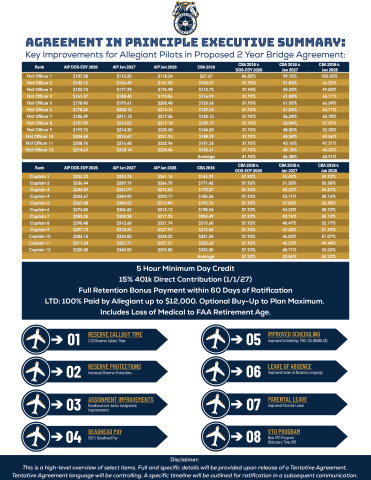
The Negotiating Committee is pleased to announce that we have reached an Agreement in Principle (AIP) with the Company on a proposed Bridge Agreement. This AIP delivers meaningful improvements across key areas including pay, retirement, scheduling, and important work rule and benefit protections, representing a significant step forward for the pilot group.

While the executive summary outlines some core provisions of the agreement, it does not capture the full scope of improvements secured at the table, many of which will be further explained and expanded upon during the upcoming Road Show following the completion of the Tentative Agreement (TA) . Our focus now turns to finalizing contract language and completing the TA process so the membership can fully review the agreement in its entirety.

Executive Summary Thumbnail

You can click the thumbnail above for a full size.
If you have any trouble, use this link:
View Full Document

Sincerely,

Your Negotiating Committee

JOINT NEGOTIATIONS MESSAGE: AGREEMENT IN PRINCIPLE

Fellow Pilots,

The Union and the Company are pleased to announce that the parties have reached an Agreement in Principle on amendments to the 2016 Collective Bargaining Agreement (CBA) in the form of a Bridge Agreement. The Bridge Agreement will take effect if it is ratified by the Union’s membership and will remain in effect until a joint collective bargaining agreement covering Allegiant Air and Sun Country Airlines is reached or the Bridge Agreement is amended by the Union and the Company.

The proposed Bridge Agreement provides for increases to wages, and improvements to retirement, long-term disability, and other provisions in the 2016 CBA, in addition to the payment of retention bonuses following ratification.

The Union will provide more detailed information in the future concerning the proposed Bridge Agreement. The next step is for the Union and Company to begin work on converting the Agreement in Principle to a Tentative Agreement. That process includes Union review of the 2016 CBA and agreed upon changes to the 2016 CBA; Company review of the same; joint finalization of the amended language; joint review of past System Board of Adjustment decisions and agreement about how those may be affected by the proposed changes; drafting and agreement on contract administration examples to avoid unnecessary grievances and disputes; agreement regarding implementation timelines for proposed changes; and joint proof reading.

When this process is completed, a Tentative Agreement will be announced by the parties. After the Tentative Agreement is announced, the Union will provide information about the ratification vote and related information.

Thank you for your support.

Sincerely,

Teamsters Negotiating Committee Allegiant Negotiating Committee

JOINT NEGOTIATIONS MESSAGE

Fellow Pilots,

The Union and the Company had two days of productive mediated negotiations in Las Vegas this week. On the instruction of the NMB Mediator, both parties will refrain from additional messages about negotiations until Tuesday, May 12, 2026.

An update will be provided on Tuesday.

Sincerely,

Teamsters Negotiating Committee              Allegiant Negotiating Committee

Jumpseat Committee Update – May 2, 2026

Fellow Pilots,

As most of you are now aware, Spirit Airlines ended all operations earlier this morning. Though the industry has seen this before, it is never an easy time for those that are most affected. It has been a longstanding tradition and show of appreciation to our fellow colleagues to get them home in these tough times. Airline pilots have always understood that we are part of a larger community, and that support across carriers matters most when one group is facing hardship.

We have received permission from Allegiant management to continue offering a spare flight attendant jumpseat or empty cabin seat to Spirit crew members through May 9th. Please reference an email from Flight Crew Operations that was sent earlier this morning for more details. We ask that our pilots please take the extra time to walk the gate area and attempt to help any Spirit crew members if they encounter issues while listing for your flight. We are grateful that our Allegiant management team is extending this courtesy to help our fellow pilots and flight attendants, and understand what a difficult time this is for so many.

Fraternally,

Your Jumpseat Committee
jumpseat@apa2118.org

Local 2118 Advisory: Spirit Airlines Announcement


Fellow Pilots,

We are aware of the announcement indicating that Spirit Airlines will cease operations as of May 2, 2026. This is a difficult and uncertain moment for many of our fellow pilots and flight attendants across the industry.

With that in mind, we ask all crews to be especially attentive to jumpseat and non-revenue travelers. When time and operational considerations permit, please take an extra moment to coordinate with gate agents and ensure that commuting pilots, flight attendants, and other non-revenue passengers are not left behind. If feasible, we also encourage crews to physically check the gate area to verify that no jumpseaters or non-revenue travelers are inadvertently stranded.

Small efforts at the gate can make a meaningful difference for those who may suddenly find themselves without a way home.

With Spirit operations now confirmed to be ending, Local 2118 will follow up in coordination with the Jumpseat Committee regarding any organized efforts to assist Spirit crews in getting to their destinations and impacts to our pilot group.

Fraternally,

Your Communication Committee