Negotiating Committee – April 21, 2025

Reorganizing for Strength!


Fellow Pilots:

Happy Easter to All Who Celebrate

We hope that our fellow pilots and your families had a great Easter weekend. We know this holiday comes at a frustrating time for many as our work for a fair contract and successful, cooperative future at Allegiant continues. Even still, we hope you were able to step back this past weekend and spend meaningful time with loved ones. Regardless of the noise, we should all remember to appreciate the quiet moments—they’re what we’re ultimately fighting to protect. We should all take time as often as we possibly can to remember what truly matters.

Different Year, Same Story

Management has a long history of attempting to undermine staffing and negotiations over scheduling. Using a data driven approach or empirical evidence has never been satisfactory to management when the numbers don’t support the Company’s demands, making it very difficult to reach an agreement on fair terms. If the Union provided any such evidence, Allegiant would try to discredit the results claiming that then current staffing is “not indicative” of the staffing levels of the future (read: they want less).

Consider the following Union update from our second round of mediation over PBS in 2019:

Your ExCo recently requested bid data so that we could compare [the PBS solution] to CBI results. In an effort to achieve full transparency, we would like to show the mediator empirical data in the form of bid results that show that the company is absolutely capable of solving our bids without unstacking and with equivalent coverage. True to form however, the company has denied our absolutely reasonable request stating “Allegiant has explained to the Union in the past, the airline is overstaffed and plans to reduce its pilot headcount over time through attrition. As such, scheduling information from Allegiant’s present operations is not indicative of what stacking and unstacking limitations may ultimately be viable once Allegiant’s pilot headcount is appropriately adjusted.” 

After our last update, some pilots questioned whether Allegiant management had the willingness or operational capacity to significantly reduce headcount. While they may be coy about their intentions today, the Allegiant management of old was upfront about their intention to slash staffing to the minimum levels. They realized that through the natural efficiency of PBS and high levels of unstacking (ignoring your preferences), they could schedule pilots at their leisure and reduce headcount to levels significantly below any other major airline.

Consider the following Union update from PBS mediation in 2018:

“When we asked why, the company said over and over that while [the PBS solution] was able to give them a good result, they didn’t know what the solution would look like when they “corrected” the pilot headcount after the fleet transition. When we asked what that meant, the company explained that we currently have 9.6 pilots per aircraft in the fleet. They will be “correcting” the number after the fleet transition to 7.1 pilots per aircraft. How does the company think they can do this? Because they have realized how efficient a real PBS solution can be in comparison to the home-built excel spreadsheet they are currently using.”

Even during our mediation in 2018, management wanted a 26% headcount reduction from already industry low staffing levels. For reference, even at our current, post-Bloch staffing level, we estimate Allegiant is over 20% less than comparable carriers. When you examine the numbers more closely on a block hour basis, Allegiant extracts 30+% greater block hour productivity per pilot in peak periods than the next nearest comparator on a relative basis based on publicly available data.


 Carrier  Pilots* Aircraft* Pilots/Aircraft G4 % Less
 Allegiant  1300  122  10.66  NA
 JetBlue  4900  289  16.96  -37.1%
 Spirit  3500  193  18.13  -41.2%
 Frontier  2200  159  13.84  -23.0%
 Southwest  11700  803  14.57  -26.8%
 Alaska  3400  236  14.41  -26.0%

Example: Approximate Pilot Count Per Aircraft

The Allegiant pilot always does more with less. In fact, it took almost 20 years for our pilots to secure even the most basic seniority protections, thanks in large part to Richard Bloch’s landmark arbitration decision. We have no intention of “forcing” the company to arbitrarily increase headcount. Our interest is in protecting what we have and what our pilots have fought for and rightfully earned through years of mediation, arbitration, and litigation.
There is no interest in contract provisions that give management the ability to significantly reduce headcount, completely devalue your hard earned seniority rights or your quality of life. Short of bankruptcy, no labor union has or would agree to such extreme concessions to fund their future contract. Our pilots expect nothing less.

“Buying” Your Own Pay Raise

After nearly four years of mediation, litigation, and arbitration, Arbitrator Richard Bloch delivered a landmark ruling in 2020 that finally ended years of scheduling contract violations and restored our seniority rights as guaranteed by the agreement that we negotiated. Unwilling to adhere to the clear, unambiguous language in our contract and the binding arbitration ruling, management resisted and filed suit in federal court to overturn the Bloch award. In 2022, their appeal was denied, and the threat of scheduling without regard for seniority or preferences was permanently put to bed – or so we thought.

It has been made clear that the Allegiant pilots are expected to fund their own pay raises through concessionary scheduling “efficiencies”. These include a reversal of the Bloch award under CBI as well as the ability to ignore preferences for the majority of our pilots after PBS is implemented. The Allegiant pilots have made it clear that this is unacceptable.

Retention Bonus Concerns

Several pilots have expressed concern about the company’s intention or requirement to pay the retention bonus upon ratification of a contract or in the event of a strike. The Negotiating Committee will not use the retention bonus agreement as a negotiating device under any circumstance. As per the original agreement, pilots should expect that the entire retention bonus shall be paid within sixty (60) days of contract ratification.

If we strike, do I lose my retention bonus?

A legal strike has no effect on the retention bonus agreement. The Union will not entertain the elimination or reduction of the retention bonus agreement as a part of any return-to-work agreement negotiated with the company. The eligibility for bonus payment requirements are set forth in Paragraph 1.a. and 1.b of the Interim Agreement: a) you remain actively employed with the Company through the ratification date of the Parties’ amended CBA; or b) you retire from the Company’s employ due to reaching the FAA mandatory retirement age prior to the ratification date of the Parties’ amended CBA. A strike does not divest a pilot who satisfies the above criteria of their right to payment of their retention bonus. Management cannot suggest, infer, or explicitly state that they will refuse to honor the terms of your retention bonus payment in the event of a legal strike.

If you have been a part of any such discussion with management, report it immediately to negotiations@apa2118.org.

General Bargaining Updates

Last week, we formally submitted a request for a proffer of arbitration and status meeting request from the National Mediation Board (NMB). In response, the NMB requested that Allegiant provide their comments no later than 29 April 2025. Allegiant requested a 2-week extension from the board so that they can “adequately respond to the Union’s assertions and provide the Board with the full context of the parties’ bargaining.” The request was granted and the deadline for management to provide their comments regarding our proffer was extended to May 13, 2025.

The Negotiating Committee had a virtual meeting with the mediator on Friday, April 18th, 2025. The parties are scheduled to meet for a joint mediation next week on Thursday, April 24th, 2025. We will keep you updated regarding any further developments.

Protect and Enforce – Understanding Contract Language

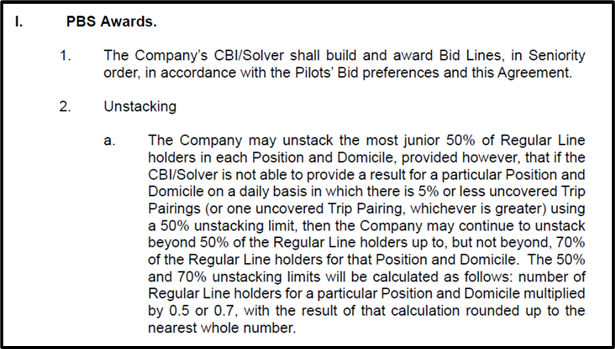
The goal of your Negotiating Committee is simple, enforceable contract language. Our pilots frequently assume contract provisions are clear—until weak or ambiguous wording is used against them. If it’s not enforceable, it is exploitable. Consider the Company’s proposed unstacking language:


Example: Excerpt from company email to pilots on December 18th

In December, the management publicly shared details of its above-quoted unstacking proposal in PBS. They characterized their proposal as having “50/70% unstacking limits” and strongly suggested that these limits were confined to “peak vs. non-peak” respectively. The truth is that this language had no requirement to prove necessity for 70%, no limit on frequency, and no mechanism for the union to review or challenge that justification. There isn’t a fixed limit or peak vs. non-peak provision. This language is wide open and easily exploited to the detriment of your seniority and quality of life. You may have already noticed the following:

“Unable to Provide a Result” Clause = Full Management Discretion

The statement “if the CBI/Solver is not able to provide a result” is ambiguous enough to be interpreted broadly and without limitation. “Solver Failure” immediately triggers higher unstacking, even if such a failure is the result of solver manipulation (as was past practice), artificial constraints, poor company planning, and/or unrealistic scheduling/staffing assumptions.

Normalizing 70% and the “Single Trip” Clause

If the “solver fails” on just one single day across a bid period, 70% unstacking is triggered. Even if there are just two “uncovered trip” on any given day, a virtual certainty if any open time is allowed to exist, then the company can ignore the preferences of 70% of line holders. For reference, 12 of our 22 bases had at least 2 uncovered trips on any given day in March 2025. Even the most minor staffing inefficiency or intentional over-scheduling triggers the limit to 70%. In short, there is no 50% limit, nor any “peak vs. non-peak” limitations in this language. It is at least 70% in virtually all cases.

70% – A Soft Limit

Another unique “feature” of this language is the so-called “unstacking limit”. By definition, a limit is not to be exceeded. The language appears to clearly express a hard limit, then in the very next clause builds in a way to bypass it. The language states:

“…up to, but not beyond, 70% of the regular line holders…”

Then the “funny math”:

“…70% unstacking limit will be calculated as follows…multiplied by 0.7…rounded up…”

If you need extra math to calculate an already mathematically defined limit, it is simply a loophole disguised as a rule.
Over 3,000 scheduling grievances and countless arbitrations, mediations, and lawsuits under the current CBA. Enough is enough. We deserve a fair contract with simple, enforceable language. We do not deserve yet another grievance making machine that sets more major airline records for arbitrations and litigation. We appreciate your support in getting it right and holding the company accountable to their end of the negotiating bargain.

Committee Changes

We welcome Captain Brad Keller to the Negotiating Committee. Captain Keller is a Line Check Airman, serves as a Steward and SPC Representative for Local 2118, and is the current chairman of the G4 Pilot Assistance Fund, LLC. Captain Keller is a former United States Marine, and has been in the airline industry since 2007. Allegiant is his 5th Airline and this will be his 4th contract. We look forward to his line oriented insight and operational experience as we intensify our efforts to reach a fair agreement at the earliest possible opportunity. Although management has informed the Union that they intend to reject his addition to the committee, the Union intends to challenge this decision.

In Closing

We are especially grateful for the many messages of support and encouragement we received over the last several days. Your Negotiating Committee is a team of your peers and we remain committed to delivering a fair contract that we can all be proud of. We continue to work tirelessly toward that goal, and we appreciate your engagement, your questions, your trust, and your support. Thank you for continuing to hold management accountable for the contract they promised you.

We look forward to delivering an agreement worthy of your vote in the very near future.


In Unity,

Captain Joshua Allen
Negotiating Committee Chairman

Captain Jay Killen
Pilot Negotiator

Captain Brad Keller
Pilot Negotiator

Captain J.R. Lynch
Chief of Staff

Captain Jim Cole
Recording Analyst


Copyright (C) 2025 Allegiant Pilots Association, Teamsters Local Union 2118. All rights reserved.

You are receiving this email as a member of APA Teamsters Local 2118.

Negotiating Committee – April 25, 2025

Reorganizing for Strength!


Fellow Pilots:

Bargaining Updates

The parties participated in a virtual mediation session on Thursday, April 24, 2025. During this session, the Company finally made a counterproposal to our January 15th, 2025 Section 15 – Scheduling and PBS LOA proposal. Let it be clear: the parties remain at an impasse. The Union’s decision to request a proffer of arbitration remains unchanged. In fact, the Company’s proposal only strengthens our resolve to seek a release from mediation. A proffer for arbitration is a required precursor to a 30-day cooling off period and any legal right to engage in self-help. Management’s proposals made it clear that they have no intention of reaching a voluntary agreement for a fair contract with its pilots. They expect you and your Union to capitulate to their concessionary demands when it comes to your seniority, schedule and quality of life.  That will not happen.  

First and foremost, management’s re-packaged 70 percent unstacking proposal doesn’t move the needle. The company continues to reject the Union’s reasonable, data-driven, and industry-supported 30/50 percent unstacking proposal. That is why we remain at impasse. The unworkable, interim or bridge PBS they are now proposing is a classic “look over here, not there” proposal designed to distract attention from an attack on the seniority rights of 70 percent or more of the pilot group.

After years of avoiding any material commitment to progress, management suddenly has a surface-level interest in “collaborating” on a faster path to a commercial PBS. The Union’s unstacking proposal is fair, properly tested, based on empirical evidence, and accommodate the “unique” aspects of the Company’s operation without completely destroying the privileges and rights of your earned seniority. We have grieved, arbitrated, mediated, and litigated this very issue for the last 10 years. It ends now.

The Company now says it disagrees with the Union’s testing. In reality, they are angry that we proved our proposals actually work for pilots and the operation. Management created PBS testing parameters that were absurd and statistically improbable, anticipating that the Union’s inability to solve them would support their position. Despite operating with 20–40% fewer pilots per aircraft than peer carriers, Allegiant set an artificially extreme bar for the Union’s “successful” PBS tests. Some components of their statistically improbable (and designed to be unsolvable) worst case setup are:

  • Every pilot coordinates to submit an identical bid in NavBlue, intentionally avoiding peak flying days (e.g., Sundays). For reference: the probability of all pilots submitting the same bid is effectively zero p = (0.5)^1300 ≈ 0.00e+00
  • Worst case scenario must be solved to best case conditions in a company-defined “problem” or “chronically understaffed” base.
  • While understaffed, in the worst-case, the statistically improbable scenario test must simultaneously meet unrealistic solve parameters:
    • ○ ≥ 20% net reserve coverage (higher than CBI results)
    • 5% open time, preferably 0% (lower than CBI results)

The result is then compared to CBI baseline metrics—despite being based on worst-case, not standard, assumptions. The test was clearly rigged for failure so they could justify their positions.

Despite this, the Union successfully solved these absurd problems per management’s request, including in bases the company claimed were “problem bases” or “chronically understaffed,” management would then reject the testing results claiming the very same bases were now “overstaffed,” or “not a problem,” or some other reason to invalidate the results. When asked to provide their results for the same problems, they could not. Curiously, management has now changed their story to claim that their “testing” (which the Union has never seen) produces different results.

The surface bargaining and shifting narratives continues with their new “implementation timeline.” Suddenly, management’s original timeline of “up to 36 months” for implementation has been whittled down to just “within months of ratification.” But don’t forget – this is all predicated on the membership capitulating to the company’s 70 percent unstacking rule. Management appears happy to accelerate progress to an industry-standard commercial PBS system, so long as the pilots are willing to give up the Bloch award, accept concessions in PBS, and trade away their seniority protections just to get there. No!

From management’s update:

“We also addressed an issue we’ve all heard a lot about lately: unstacking. A lot of what the Union has recently said on this topic is inaccurate and misleading. In the coming weeks, we plan to address those points so you know the truth about how unstacking works.” 

Management continues to insist that they alone have a monopoly on “the truth.” Their managers, with a documented history of spreading misinformation and outright lies, will now use their less-than-elementary understanding of NAVBLUE and commercial PBS systems to explain to you how unstacking works—because clearly your Negotiating Committee and/or a cursory Google search is insufficient. The industry agrees how it works. The vendor agrees how it works. The only people that don’t agree are Allegiant managers. Perhaps they will enlighten us and the entire industry with their “truth” presentation. But while they are wasting their time, ours, and yours on presentations, keep in mind they refuse to agree to industry standard unstacking rules to protect your seniority, and no “presentation” will change that fact.

If our previous unstacking updates were “inaccurate and misleading,” in just a few sentences management could have:

  • Refuted the Union’s testing and reassured our pilots that they would not reduce headcount – they did not.
  • Refuted that they have demanded concessionary reversals of the Bloch award to “fund your pay raises” – they did not.

  • Refuted that their proposal actually allows for unstacking limits well above 70% of lineholders – they did not.
  • Refuted that their proposal does not place any limitations on peak vs. non-peak periods for unstacking limitations, the standard practice industry wide – they did not.
  • Refuted that they have a documented history of ignoring or attempting to delegitimize empirical data regarding PBS to better suit their narrative – they did not.
  • Refuted that management intends to significantly reduce Open Time flying – they did not.
  • Reassured pilots that regularly scheduling flying lines close to FAA maximum limitations is not a part of their scheduling “efficiency” plan for the future – they did not.

And when it comes to their overall lack of credibility, they could have:

  • Refuted that they refused to adhere to the binding Bloch Award arbitration after the PBS settlement with the union, only to lose their appeal in federal court – they did not.
  •  Refuted that management has plans to close additional bases in our system – they did not.
  • Refuted that management used the LAX pilots and their families as human bargaining capital and that narrative surrounding changing “economic conditions” as a lie – they did not.

As is standard at Allegiant, management is silent and unresponsive when faced with empirical data and facts. Unsurprisingly, management now needs extra time over “the coming weeks” to engineer the “truth” they need to show you—because only management knows the truth. Don’t waste your time reading it. Follow this link to learn “the truth” directly from the software vendor. Pay particular attention to the Processing Logic section for a deeper dive on how PBS really works.

From management’s update:

“…we’ve proposed that during the scheduling process, if the Union can come up with a solution that does not require more than 50% unstacking and complies with the other contractual and FAR rules, the Company will accept that solution. This proposal means that the Union will have the ability to ensure that the Company will not unstack beyond 50% so long as it can produce that solution…”

The emails and texts we received suggest that our pilots have already seen right through this. Surface bargaining disguised as “collaboration” and progress, while somehow putting the operational liability for staffing on its pilots. First, in the company’s proposals the Union would have absolutely no control over any of the key variables that affect unstacking – no control on staffing, scheduled trips, trip mix, open time, etc. The company would have complete discretion to change the variables at will—such as reducing headcount or manipulating trip construction—which would make solving unstacking impossible. Even still, management suggests that they would accept a solution below 50% unstacking—if only the Union could make it work. That’s the equivalent of management giving you a car with four flat tires, no spare, no roadside assistance, and no phone—and then saying, “If you can still make it to work on time, we agree not to discipline you.” It’s a recipe for decades more of the same: endless grievances, arbitration and lawsuits while the Company mows down our seniority rights and quality of life.

From management’s update:

“Out of respect for the mediation process, we’ve refrained from making direct comments about that request.”

After our proffer request, management has suddenly found “respect for the mediation process.” The company’s history of leaking confidential bargaining information, sending out cut-rate mailers to your spouse, spreading misinformation, disparaging the Union in recurrent ground school, spreading false rumors about the Negotiating Committee, and a host of other activities is well documented and will be shared with the NMB when the opportunity is presented.

The parties remain at an impasse. Management’s April 24, 2025 proposal has done nothing but reinforce that reality. Any messaging from the Company suggesting that progress was made, that they have moved in our direction, or have “given the Union everything they are asking for” is false. They have not. We remain committed to reaching a fair agreement that reflects the realities of our operation and the value you bring to this airline every day.

The Sky [Isn’t] Falling

Management continues to paint a dire economic picture to lower your bargaining expectations. Unsurprisingly, the data tells a different story. Allegiant saw a 14.4% growth in passengers in March alone, with an increase in revenue passenger miles (RPMs) of almost 16% as compared to the same period last year. Available seat miles (ASMs) grew much more aggressively, up more than 20%.

Management seems to conveniently “forget” its statements, on public record, about its own operation. Consider the following quote from Allegiant’s CEO Greg Anderson:

“…our model for the past 20 years has been wildly successful, whether high fuel, whether low fuel, whether it’s a strong economy or whether it’s a weak economy, we have consistently outperformed the industry.”

Management cannot have it both ways: proclaim growth and resiliency to Wall Street while complaining to pilots that they are “too poor” and need scheduling concessions to pay below market wages. Allegiant is not in “survival” mode. Our pilots deserve and will obtain a contract that reflects the reality of your contributions to this carrier. Your expectations should continue to reflect that.

Passenger Productivity

What really drives value? Passengers. “Allegiant” isn’t paid by the Block Hour – they’re paid for safely moving people. The question isn’t whether the aircraft flies on Tuesdays—it’s how much work our pilots do for every customer moved.

Based on the most current DOT information, Allegiant pilots safely transport the highest number of passengers per pilot of any airline in the industry – over 14,400 per pilot in 2023. Each pilot is responsible for 50.1% more passengers per year than jetBlue, 16.9% more than Spirit, 13.1% more than Southwest, 66% more than United, 115% more than Sun Country, and 51% more than Delta. Aircraft may be sitting, but the pilots are not.

You fly the most passengers per pilot – with less support, less schedule choice, less protections, and less pay than your peers. You are not underutilized, you’re underpaid – with the worst work rules across the industry. Enough is enough.

Financial Productivity

Empirical data can tell us more about our pilots’ contributions to the financial success of this airline. Between 2017-2023, Allegiant ranks #1 in average operating income per pilot – ahead of every ULCC, Delta, and United, and #2 in net income per pilot, second only to Southwest. You drive industry-leading financial performance for this carrier – money which was promptly spent on failing resorts, golf courses, family fun centers, and the like. Allegiant pilots are high value, not low cost, yet management continues to refuse to invest in its own pilots.

Consider management’s own words if there remain any doubt:

“Allegiant stands out with a revenue premium close to brand carriers like Delta, American, and United…” – Greg Anderson, CEO

“Our unique balance of revenue and costs drives higher margins than Delta, Alaska, JetBlue, Southwest, and Frontier.” – Greg Anderson, CEO 

“…you might be surprised to know that our customers do consider other airlines before choosing us. And for the most part, it’s not other low cost carriers. It’s really the big four, Southwest, Delta, American, and United. They consider those airlines and they choose us.” -Scott Sheldon 

Whether the aircraft “sits on Tuesdays” or not is completely irrelevant to your work and contributions to this airline. Allegiant pilots produce significantly more for their airline than any of their peers – all within the confines of a bare bones operation with limited support when things go wrong. The Allegiant pilots schedule and quality of life are objectively worse compared to our peers thanks to no trip rigs, virtually no schedule construction rules, thinner staffing, less reserves as compared to our peers, and limited opportunities for schedule adjustment.

Ask our central Florida based pilots how much this so-called low utilization model improves their schedule quality—or how much it reduces the time they spend crisscrossing the state in Larry’s Limo to rescue a purposely understaffed operation. Ask any seasoned Allegiant Captain to describe their misadventures with outstation maintenance. The real Allegiant “difference” is that Allegiant pilots do more with less.

Management’s mistake is believing that our pilots should expect less—we do not.

In Closing 

The Union remains resolute in its decision; no further progress will be made nor will any fair agreement result from mediation without the economic pressure of a 30-day cooling off period and threat of strike. Allegiant’s games have run their course. We will not settle for a substandard agreement at this juncture.


In Unity,

Captain Joshua Allen
Negotiating Committee Chairman

Captain Jay Killen
Pilot Negotiator

Captain Brad Keller
Pilot Negotiator

Captain J.R. Lynch
Chief of Staff

Captain Jim Cole
Recording Analyst


Copyright (C) 2025 Allegiant Pilots Association, Teamsters Local Union 2118. All rights reserved.

You are receiving this email as a member of APA Teamsters Local 2118.

Negotiating Committee – April 14, 2025

Reorganizing for Strength!


Fellow Pilots:

Forced Work + No Preferences = Less Pilots

This is a simple, data-driven exercise that you can imagine for yourself. If you own a business and can force your employees to work at-will, on the days of your choosing, you need significantly less people in your workforce. In the case of an airline, if your only “structural” limits are FAR Part 117 rules and a few limited scheduling provisions, both the number of pilots in the workforce and the resultant quality of life for those pilots who remain reduce dramatically. Our pilots are a resource to invest in, not simply a property-like cost that must be controlled as management prefers.

Management has not been coy about their desire to minimize headcount and increase productivity through force. The only cost is your quality of life, your real earnings, and fewer pilots on property – sacrifices management is obviously willing to make. Management repeats the “unique business model” and “operational necessity” excuse, hoping for emotionally driven concessions. Fortunately, data is not swayed by emotion. High unstacking/forced work is not a “necessity for our unique operation” and the data proves it. Removing your seniority from the equation and forcing work is a wholly unacceptable concessionary proposal that predates these negotiations.

The idea that giving management a concessionary contract is necessary for the company’s survival is nonsense. In conjunction with a strong business model, a fair contract increases productivity and profits. Airlines like Southwest and Alaska achieved record earnings under new pilot contracts, while still respecting seniority and providing for a decent quality of life. Allegiant would be wise to do the same.

Continued Clarification Regarding Current CBI

There continues to be some misinformation regarding schedule, specifically that the company’s offer is superior to CBI with respect to honoring seniority and preferences. It is worth repeating that CBI is a 0% unstacked solution as guaranteed by the Bloch award. The company’s proposal on PBS represents a major concession from the current contract.

Some think, “My schedule is great, I don’t see the problem”.

Your schedule is satisfactory because the Bloch award guarantees that your seniority is honored in CBI. The status quo will change and will be worse under the company’s proposal. In the company’s proposed scheduling environment, broad, new unstacking rights would give the company the ability to ignore seniority and build schedules entirely at management’s discretion. Management has previously made it clear that any improvement to pilot pay must be tied to concessions in scheduling. In their proposal, you are buying your pay rates through giving up seniority, your quality of life, and sacrificing our junior pilots.

As any labor union would, we find this proposal wholly unacceptable.

Disciplined Bargaining

The RLA bargaining process is time consuming, difficult, and frustrating. Many pilots question why we remain in mediation when the company and Union have not been able to reach an agreement on fundamental working conditions while management engages in bad faith behavior, shows a lack of cooperation, and disregard for the bargaining process. First, the National Mediation Board alone determines if and when the parties are released from the mandatory mediation process. Second, as discussed below, we wanted to use all of the means at our disposal to try to reach an agreement before we requested a release to self-help, which is a costly, last resort option available to both parties if released from mediation by the NMB. Because of its potential economic impact, self-help is never the desired outcome, but sometimes the only viable way to reach a fair and enforceable agreement.

There is no operational need for the company’s concessionary and extreme bargaining demands. Moreover, through deliberate stalling, misinformation campaigns, and bad faith tactics, management has attempted to use mandatory mediation time to wear down and divide the Union. They know that the RLA process requires the parties to spend a substantial amount of time in negotiations before being released by the NMB, and they attempt to use that delay to their advantage—engaging in “surface bargaining” to make minimum progress while creating division in our ranks in an attempt to entice pilots to accept concessions and settle for less.

Instead of frequently complaining, we used a disciplined, data-driven approach to provide solutions to each and every company problem they presented, no matter how “unsolvable” or trivial, in an attempt to reach agreements; we could not. We kept detailed records of the company’s behavior, including shifting positions, their near “unsolvable” parameters and frequent obstructionism.

We believe a 30-day cooling off period, followed by self-help, if no tentative agreement is reached, is necessary to produce a contract. We have a well-documented, evidence-based case to present to the National Mediation Board (NMB) should a status meeting be granted. Our reports include a detailed record of why we have reached an impasse, the company’s conduct at and away from the bargaining table, the Union’s good-faith efforts, and our conclusion that a release to self-help is justified and necessary to reach a fair agreement.

Self-Help Process FAQ

Based on our filing to the NMB requesting release from mediation, some of our pilots have additional questions regarding the NMB bargaining process, the status of mediation, and the possibility of self-help. Over the next several updates, we will attempt to answer all of your outstanding questions. Additionally, expect more communication and to receive a Strike Preparation Handbook from the SPC.

1. Is there a timeline or time limit for the NMB to respond to the Union’s request “for a proffer of arbitration”?

No. The NMB has full discretion and there is no mandatory timeline to respond to a request for a proffer of arbitration, the formal name for a request to be released from mediation. There is no statutory deadline and the NMB will base their decision on multiple factors. A status meeting between the parties and the NMB may occur before a decision on our proffer request will be made. During the status meeting, the Union will present its evidence-based case for how the company’s proposals and conduct have created the current impasse. If a status conference occurs, management will also be given the opportunity to present its case.

2. How long does the process generally take if the mediator grants our request? When can self help begin?

To clarify, while mediators provide their opinion to the NMB, mediators do not grant or deny a request for a proffer of arbitration. A proffer request and related decisions are made by the three member, presidentially appointed NMB members. If the NMB makes the proffer of arbitration and either party rejects arbitration (which the Union will), then the 30-day cooling-off period before self-help can legally begin starts immediately. The parties can lawfully engage in self-help immediately after the cooling off period expires.

3. What is self-help and what can the Union do during that time?

It is commonly misunderstood that self-help simply means a strike alone. In reality, self-help applies to both parties equally under the law. During self-help, the Union may legally strike the employer, either in full or in an intermittent, unpredictable fashion. At the same time, the employer can lock out employees and unilaterally change wages, rules, and/or working conditions (e.g., implement the “mailer”) in an attempt to encourage pilots to cross the picket line to work (“scabbing”). An employer can also attempt to hire replacement workers, although the training for flight crews makes this costly and impractical.

4. If the NMB grants our request, what should we expect and how long will it take?

There is no timeline for the NMB to make a decision on a request for a proffer of arbitration/release. If the NMB decides to make a proffer, the parties will be notified that the NMB has terminated its services and is making a proffer of binding arbitration. The parties will either accept or reject arbitration. If either or both parties refuse arbitration, the NMB immediately releases the parties into a 30-day cooling off period.

During the 30-day period, it is common for the parties to engage in “super mediation.” This is a compressed period of multiple, intense bargaining sessions with the intent of reaching an agreement to avoid a strike. If this does not lead to an agreement, the parties will be released to self-help at the end of the cooling off period.

5. If the NMB does not grant the request, what happens?

If the NMB believes that further mediation without economic pressure could be productive and lead to an agreement, the request may be denied. The parties will remain in mandatory mediation. The Union believes that it has gone well beyond every reasonable effort to make an agreement. We do not believe further “no stakes” mediation will lead to an agreement.

Your Duty as a Pilot

Consider the source; they’re not “just like us” – Regardless of their flying background, managers are just that, managers. They aren’t “just like us” and they aren’t “here to help.” These former line pilots are not like you and do not bargain for your best interest. Most have vested stock options, the freedom to control their own schedules, and they won’t live under the contract they are negotiating “for you.” Should they ever return to the line, they’ll have the privilege of avoiding the worst of whatever is negotiated through their seniority.

Combat Misinformation
– There is a significant amount of misinformation being spread on non-official forums and group chats. It is every pilot’s duty to speak up and out against misinformation, especially against those most clearly aligned with management’s agenda to undermine our unity and subvert the Union’s bargaining authority. Silence is surrender.

Report Illegal Behavior – By law, management cannot interfere with union affairs in any manner, especially one which affects their ability to bargain or represent its members. Inappropriate and reportable behavior includes, but is not limited to:

  • A manager suggesting, encouraging, or directing a “decertification” or “start an ALPA drive” effort in any form, as some managers have been known to do (including those managers who approached members of your Negotiating Committee asking them to participate in such actions).
  • A Check Airman or Instructor who utilizes a training session, scheduled or “surprise” line check, or other official event to disparage or undermine the union, encourage certain political outcomes, or similar behavior. Any training/checking event should be free from Union, management, or political pressures.
  • Management conversations (including calls, texts, or emails) with line pilots about their preferences for Union representatives or representation, or how to resolve disputed issues during negotiations.
  • Any individual, manager or otherwise, who actively colludes with Allegiant to undermine the representational effectiveness of the Union.

Report any suspected violations to negotiations@apa2118.org. As we prepare for a potential status meeting with the NMB, additional reports will be particularly useful over the coming days and weeks.


In Closing


Thank you for your support. We look forward to delivering an agreement worthy of your vote very soon.

In Unity,

Captain Joshua Allen
Negotiating Committee Chairman

Captain Jay Killen
Pilot Negotiator

Captain J.R. Lynch
Chief of Staff

Captain Jim Cole
Recording Analyst


Copyright (C) 2025 Allegiant Pilots Association, Teamsters Local Union 2118. All rights reserved.

You are receiving this email as a member of APA Teamsters Local 2118.

Contract Comparison (October 2024)

contract compare