

Negotiating Update – April 15, 2024

Allegiant Air Pilots,
This week, your negotiating committee was fully engaged each day preparing for upcoming negotiation sessions. We are not only prepared but also highly motivated to secure the contract you have rightfully earned… and in a timely manner. As previously reported, last week the Union passed Sections 25 and 12, while Section 5 was passed back in February. We look forward to responses on these three (3) sections from the Company in the near future.
Here’s a breakdown of our activities this week:
Monday and Tuesday – We continued our preparation, focusing on Sections 14, 15, and 16. Our financial analyst also met with the company then delivered a briefing to the committee on the current state of the retention bonus pool.
Wednesday – The committee received a comprehensive briefing from Attorney Michael Urban. The discussion revolved around outstanding and past grievances, arbitrations, and settlements, with a focus on the current and potential future impact to your contract. The remainder of the day was spent formulating negotiation strategy based on the insights provided by Mr. Urban.
Thursday – We met with the Compensation Committee and initiated an in-depth review and audit of the company’s payroll practices. This included addressing conflicting interpretations of our current contract language and provisions. It has become clear that the current payroll process is inconsistent and outdated, requiring essential improvements to both your contract and the company’s systems. We are committed to ensuring our pilots are compensated per the contract in a consistent and reliable manner. In other words, you should not have to “police” your paycheck.
Thursday Afternoon – We dedicated our time to analyzing industry best practices in reserve work rules, systems, utilization, staffing, and quality of life.
Friday – We reviewed the initial findings of the Compensation Committee and would like to publicly acknowledge their excellent work. We also reviewed an initial internal draft of contract terms and definitions. This comprehensive list covers all aspects of your contract, including Section 2 Definitions, FARs, necessary section-specific needs, LOAs, settlements, and Side Letters. To date, we have compiled and defined over 200 terms, and we anticipate more as we progress through the negotiation process. We are committed to clear and concise contract language that benefits both our Pilots and the Company alike.
Saturday – We concluded the week by writing this update.
Sunday to Sunday – Throughout the week, we monitored and analyzed the data collected from the most recent survey. The engagement and input of our members are the most useful tools to positively affect negotiations. We are pleased to report an impressive response rate of approximately 75 percent. Just under 1,000 pilots shared their voice in the span of a week.
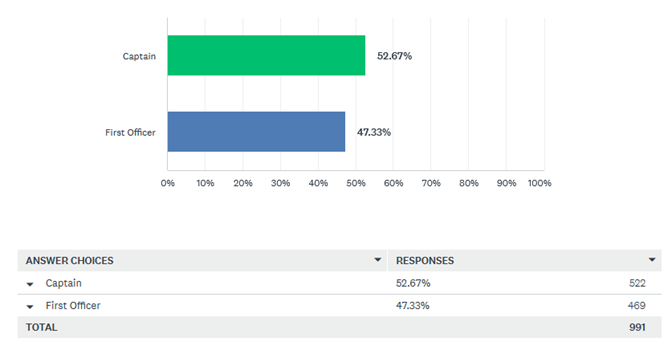
Topic of The Week: RIGs
RIG = The base definition of RIG is “Ratio In Guarantee,” however, In the context of pilot contracts, a “RIG“ has evolved and refers to a mechanism that ensures pilots receive fair and reasonable credit toward pay for services rendered, regardless of actual time spent between block-in and block-out times.
There are two main types of rigs: Trip Rigs and Duty Rigs
Trip Rigs: A trip rig is pay credit based on time away from base.
This means that from the time a pilot reports for duty until the time they are released from duty in domicile equals a quantity of time. For example, a 1:3.5 trip rig means that for every 3.5 hours that a pilot spends away from domicile (i.e., on a trip), they are paid one hour at their specified hourly rate.
- Example: Dave reports for duty in his ANC domicile at 1500Z (Zulu time) on Monday. He flies to SLC and arrives at 1900Z. He has a 30-minute debrief, so he is released from duty at 1930Z. He has an SLC layover and flies back to ANC the next day, arriving at 2000Z, with a release time of 2030Z. He was away from domicile for a total of 29:30 hours. In order to find out what a trip rig would pay on this, you would take 29.5 and divide it by 3.5. The result is 8:42. If you were paid for this trip using a trip rig, this is the amount times your hourly rate that you would receive.
Duty Rigs: A duty rig is pay credit based on the amount of time that a pilot spends on duty.
For instance, if the duty rig that a contract offers is 1:1.5, this means that for every 1.5 hours that a pilot spends on duty, they are paid for 1 hour multiplied by their current hourly rate of compensation.
- Example: Harley reports for his trip in ANC at 1900Z and departs at 2000Z for YWG. He arrives at 0030Z in YWG and departs for ORD at 0200Z, arriving at 0330Z, with a release time of 0400Z. His total duty can be found by subtracting his release time from his report time for the duty period. This equals 8 hours. If the duty rig that his contract offers is 1:1.5, this means that for every 1.5 hours that Harley spends on duty, he is paid for 1 hour multiplied by his current hourly rate of compensation.
These rigs incentivize the airline to construct aircraft flows and route structures that complement the pilot-pairing construction process. They also help ensure that pilots’ compensation is correct. Many airline contracts include these rigs, but some may be devoid of them, so a pilot is only paid for block time, which is not industry standard or equitable.
Here are some examples of other common types of RIGs used in pilot contracts:
Duty Period Average: Minimum credit value placed on each duty period contained within the pairing. For instance, a pairing that touches 3 calendar days but only contains 2 duty periods will credit the duty period average rig for 2 instances.
Average Minimum Daily Guarantee: Minimum credit value required for each calendar day that is encompassed by the pairing, regardless of how many duty periods are contained within the pairing.
Time Away From Base (TAFB): Credit value based upon the report time on the first day of a pairing and ending at the release time on the last day of the pairing.
Sit Time RIG: Value based upon time sitting in between flights while not on the Block-to-Block clock.
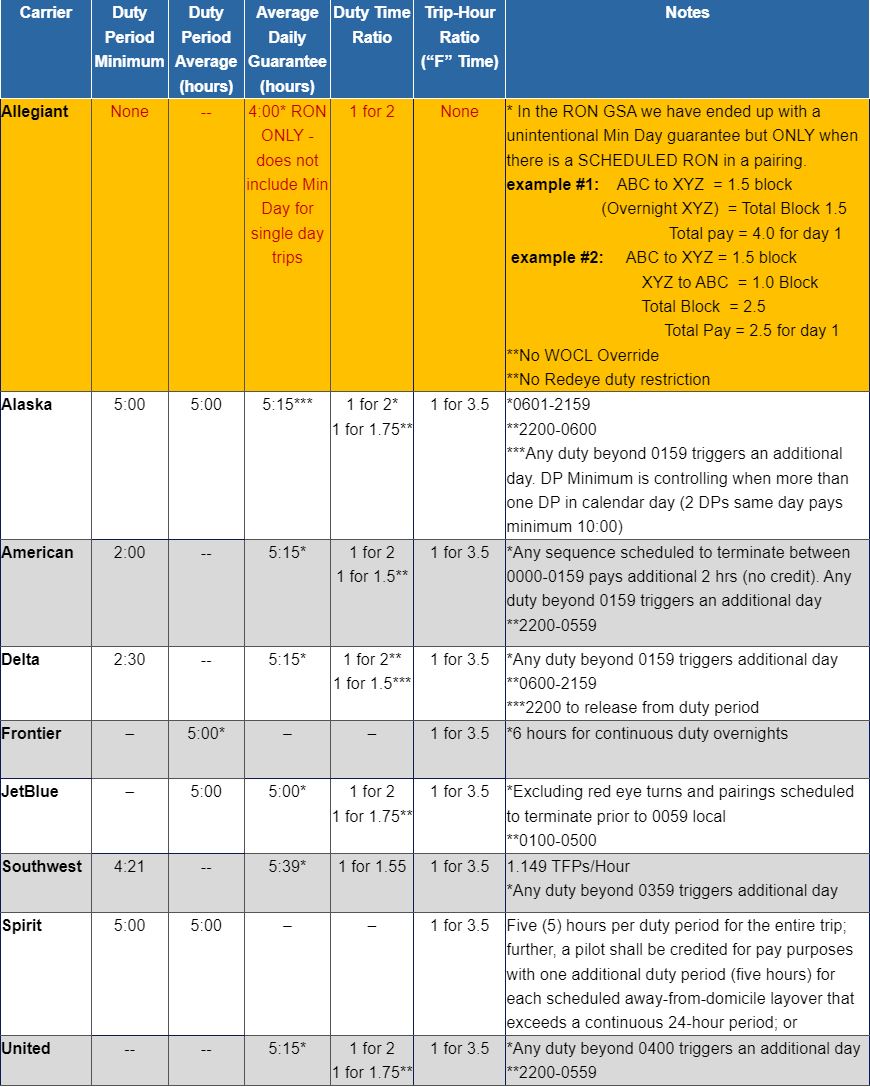
Here is how your contract compares to current peer pilot contracts:
Thank you for your continued support and engagement. Together, we can achieve a contract that truly reflects your value and contributions to Allegiant Air.
Fraternally,
Your Negotiating Committee
Allegiant Pilots Association, Teamsters Local 2118